
Bay Projected Versus Actual Release
Florida law uses precise terms. The Maximum Sentence Expiration Date, or MSED, is the full-term endpoint after lawful credit. The Tentative Release Date, or TRD, is the projected custody-release date after gain-time awards and forfeitures. FDC's public current record visibly labels a field Current Release Date. None is a guaranteed appointment.
A pretrial Bay County Jail detainee has no sentence-based TRD. Bond, recognizance, dismissal, a later sentence, and other holds determine release. A court order may authorize release before BCSO completes checks. The jail record supplies physical checkout time.
Find Bay County Projected Release
Start with the last known system. Bay Correctional Facility and Panama City Community Release Center are FDC settings. The latter's name does not mean the person has been discharged. County Jail and Annex records belong to BCSO and the Bay Clerk.
- Confirm the identity with full name, birth date, DC or booking number, and case number.
- For state prison, open FDC Inmate Population and read Current Release Date with status and location.
- For a county sentence, read the Bay judgment and ask BCSO for its release calculation.
- For pretrial custody, check bond and court orders, then ask BCSO about holds.
- Recheck the source close to the date because calculations can change.
- After exit, verify the actual transaction and any supervision status.
The FDC screenshot captures the exact public field label.
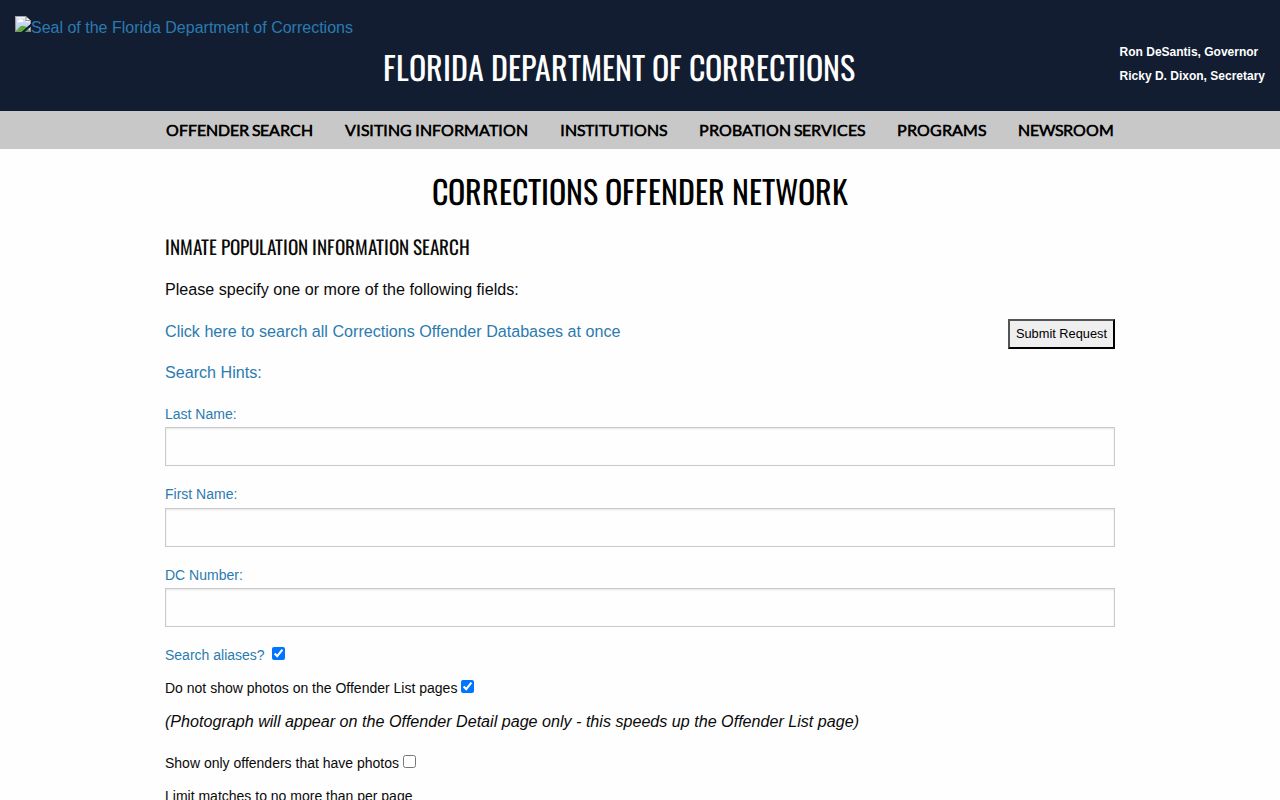
Report that label as shown and do not silently rename it a guaranteed date.
Bay State-Prison Gain-Time Rules
Florida Statute 944.275 governs FDC gain-time and tentative release calculations. For qualifying offenses committed on or after October 1, 1995, the statute generally permits up to ten days per month of incentive gain-time, but awards cannot produce release before 85 percent of the imposed sentence is served. Court credit for physical custody counts toward that floor.
Maximum gain-time must never be assumed. FDC awards, restores, and forfeits credit based on the actual record. Older offense dates have different rates. Mandatory minimums and special exclusions can require more time, and covered newer sexual-offense sentences face additional restrictions. A life sentence remains for natural life unless lawful clemency or pardon changes it.
The statute image shows the TRD framework and 85 percent boundary.
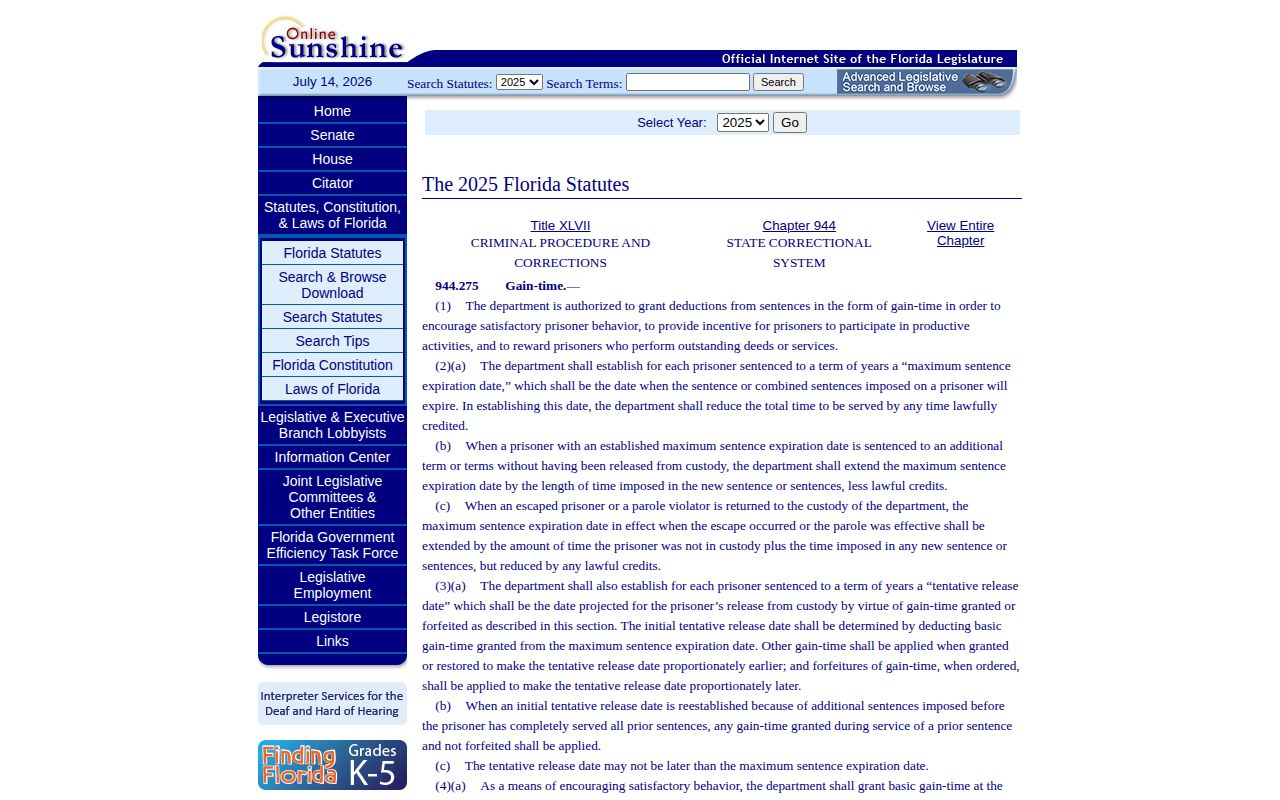
Only FDC can provide the operative calculation for an individual state commitment.
Why Bay Release Dates Change
A date is recalculated when the facts behind it change. Compare the newest FDC detail with the court sentence and incarceration history rather than relying on an old screenshot.
| Factor | Possible effect |
|---|---|
| Gain-time awarded or restored | May move TRD earlier, subject to legal floors. |
| Disciplinary forfeiture | Can move the date later. |
| New or consecutive sentence | Changes the combined term. |
| Mandatory minimum | Creates a date that ordinary credit cannot advance. |
| Detainer or hold | May cause transfer instead of community release. |
| Escape or violation return | Can trigger forfeiture and recalculation. |
| FCOR action | May affect eligible parole or conditional-release cases. |
Section 944.28 authorizes forfeiture for escape, revocation, and serious misconduct. Conditional release can start when prison custody ends, so release on the date may still lead to supervision.
Confirm Bay County Release Dates
FDC's Bureau of Admission and Release can assist at (850) 488-9167 or dc.release@fdc.myflorida.com when a public date conflicts with the sentence. Classification and Central Records is available at (850) 488-9859. For county custody, call Bay County Jail at (850) 785-5245 and request the historical release route.
The Bay County VINELink inmate search can register an alert, but its reported event must be confirmed with FDC or BCSO. The Bay County released-inmate record path helps after the projected date passes. A person may leave secure custody and remain under state supervision.
Bay County Jail Gain-Time
County jail calculations use Florida Statute 951.21, not FDC's 85 percent formula. Unless local policy changes it, the law authorizes up to five days per month in years one and two, ten days per month in years three and four, and fifteen days per month from year five, plus up to five days per month of meritorious credit on recommendation. Misconduct can forfeit credit.
The county statute image documents the separate system.
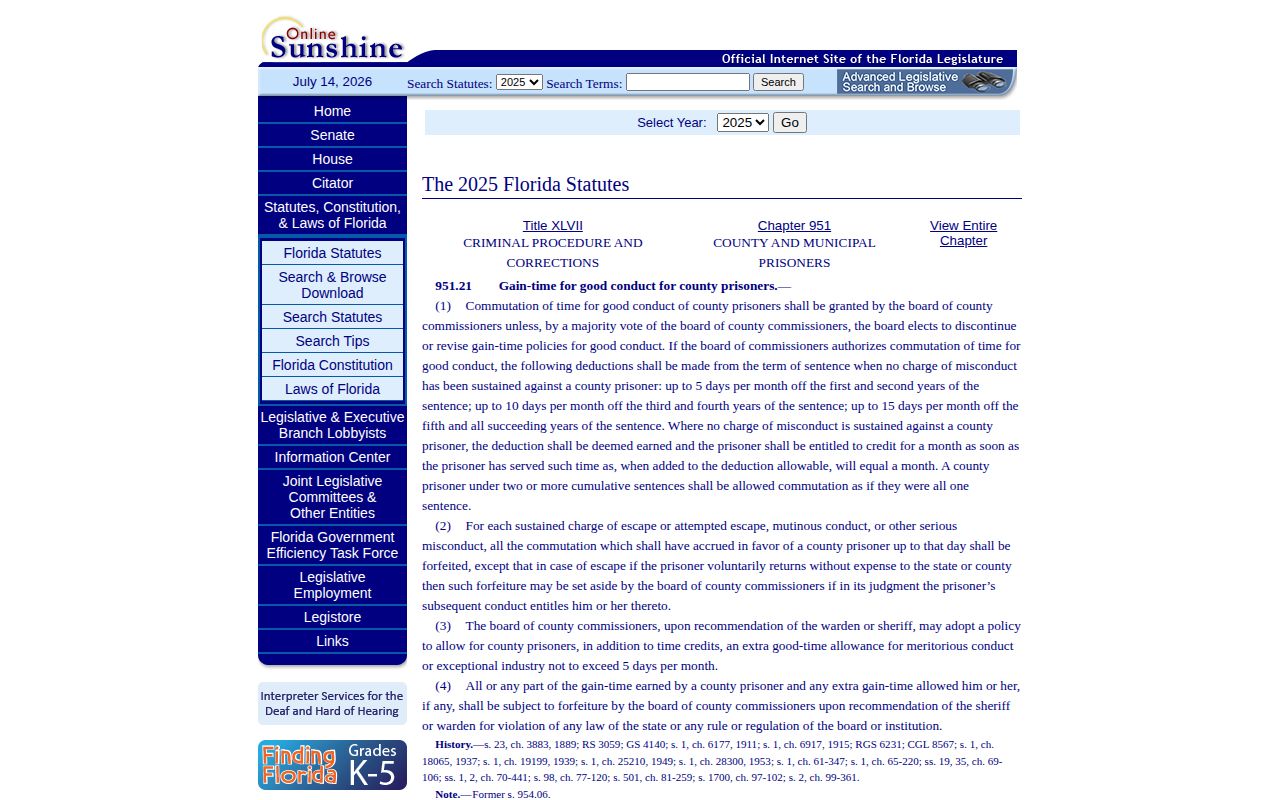
No verified statewide law automatically moves a Bay jail weekend or holiday release to Friday. Ask BCSO for the current calculation and operational policy.
Section 951.04 separately addresses transportation or equivalent money for a county prisoner discharged after serving a sentence, pardon, or parole. Its wording does not establish the same benefit for bond or dismissal. BCSO's release and transportation instructions are the more direct source for those local paths.
Note: State and county credit systems are distinct, so never apply the FDC formula to a Bay County Jail sentence.
Calculate Bay State Release Terms
A sound explanation begins with the imposed state term and lawful jail or prison credit, which form the MSED. Next identify offense dates, mandatory minimums, and exclusions. Apply only gain-time FDC actually awarded or restored, then subtract any forfeiture. Enforce the 85 percent floor and every stricter non-advanceable date. Added sentences, concurrent or consecutive terms, escape, and violation returns can require another calculation.
This sequence explains the record without predicting a personal date. FDC has access to the controlling sentence structure, credit ledger, discipline, and holds. A family calculation based on the maximum monthly award can be wrong even when the arithmetic is sound. The public Current Release Date remains the practical field to recheck.
Conditional release adds another layer. Certain repeat or habitual offenders can leave incarceration at the TRD under supervision rather than receive a full discharge. FDC supplies eligible names and numbers to FCOR before the date. The release and supervised-population records must therefore be read together.
Bay Pretrial Release Has No TRD
A Bay County Jail detainee awaiting trial is not serving an FDC sentence merely because the person is in custody. First appearance, bond, recognizance, dismissal, and later court orders control the path. If no bond has been set, BCSO says first appearance generally occurs within 24 hours. The judge may set bond, hold without bond, or order recognizance release.
The release desk must still receive and verify the order and check outstanding charges. A detainer can produce a transfer. Search the Bay Clerk Events section for the legal authority, then ask BCSO for the release timestamp, code, holds, and receiving agency. This is why no projected date should be invented for a pretrial booking.
Bay Release Rules by Offense Date
Offense date controls which Florida gain-time rules apply. Basic gain-time applies to offenses from July 1, 1978 through December 31, 1993. The statute sets different incentive maxima for pre-1994 offenses and for offenses from January 1994 through September 1995. The familiar 85 percent framework generally applies to qualifying offenses committed on or after October 1, 1995.
Specified sexual offenses have added restrictions, including an incentive-gain-time bar for covered sentences after July 1, 2023. Mandatory minimums and other non-advanceable provisions can require more than the ordinary floor. A release estimate that uses only sentence length and a broad percentage can therefore be wrong.
The FDC record and sentence documents should be read together. Capture the offense date, sentence date, sentencing county, prison term, and case number. Added or consecutive sentences can alter the combined term, while concurrent terms may run at the same time. Only FDC can apply the full lawful calculation to the state commitment.
Bay Release Holds and Detainers
A projected custody-release date does not answer where the person goes next. FDC's released-detail record can include detainers with the date, agency, type, and cancellation date. A current detainer may lead to transfer when Florida prison custody ends. The same problem exists at Bay County Jail, where the Releasing Section performs another outstanding-charge check.
An ICE detainer asks a jail to notify ICE before ordinary release and requests a hold for up to forty-eight additional hours so ICE can assume custody. Bay has documented immigration-cooperation history, but the older agreement does not prove current participation. Request the receiving agency for the actual booking and use the ICE locator if a handoff is plausible.
A federal warrant or another county hold can also change the destination without changing the fact that one sentence reached its release point. Describe the event as release from the named custody system and transfer to the receiving agency. Do not describe it as community freedom unless the transaction supports that conclusion.
Bay Parole Dates Stay Tentative
Florida parole applies mainly to narrow older-offense categories. FCOR may establish a Presumptive Parole Release Date during an Initial Interview. That PPRD is not physical release. Later interviews can keep, shorten, extend, suspend, or establish an effective date based on the case stage, institutional conduct, and an acceptable release plan.
The Commission Voting Schedule and detailed agenda show future matters, not final results. An Effective Interview label does not mean parole was granted. Obtain the Commission Action or order, then check the FDC release and supervision records. Administrative processing can continue after favorable action.
Modern prison records are more likely to involve gain-time sentence expiration, conditional release, conditional medical release, or another statutory mechanism. Use the exact FDC or FCOR term rather than calling every projected prison exit parole. The FDC supervision record explains how to verify the status after custody ends.
Verify Bay Actual Release Events
Once the displayed date passes, move from projection to transaction records. For state prison, search FDC Inmate Release by full name or DC number. Read the Release Date, custody history, newer incarceration entries, detainers, and supervision result. An old release remains part of the record even when a later commitment controls present custody.
For Bay County Jail, ask BCSO for the booking and release timestamps, release type or code, court authority, outstanding holds, and receiving agency. Compare the Bay Clerk Events section for the order or sentence. Court action can precede the jail's physical checkout, so the two timestamps serve different purposes.
Florida VINE can supply a reported event and notification time. Treat that alert as a prompt to check the originator. BCSO, FDC, the court, BOP, or ICE remains the authoritative source for its own custody transition. Preserve the source and access date so an older projection is not mistaken for the final event.